What Is a Lady Bird Deed?

A lady bird deed is a special type of deed that transfers real property at the owner’s death without probate. In Florida, a lady bird deed allows the owner to keep full control during life, including the right to sell, mortgage, lease, refinance, change beneficiaries, or revoke the deed entirely, without the beneficiaries’ consent or knowledge. The property then automatically passes to designated beneficiaries when the owner dies.
Florida does not have a transfer-on-death deed statute, so the lady bird deed is the simplest way to transfer property at death outside of probate.
How Does a Lady Bird Deed Work?
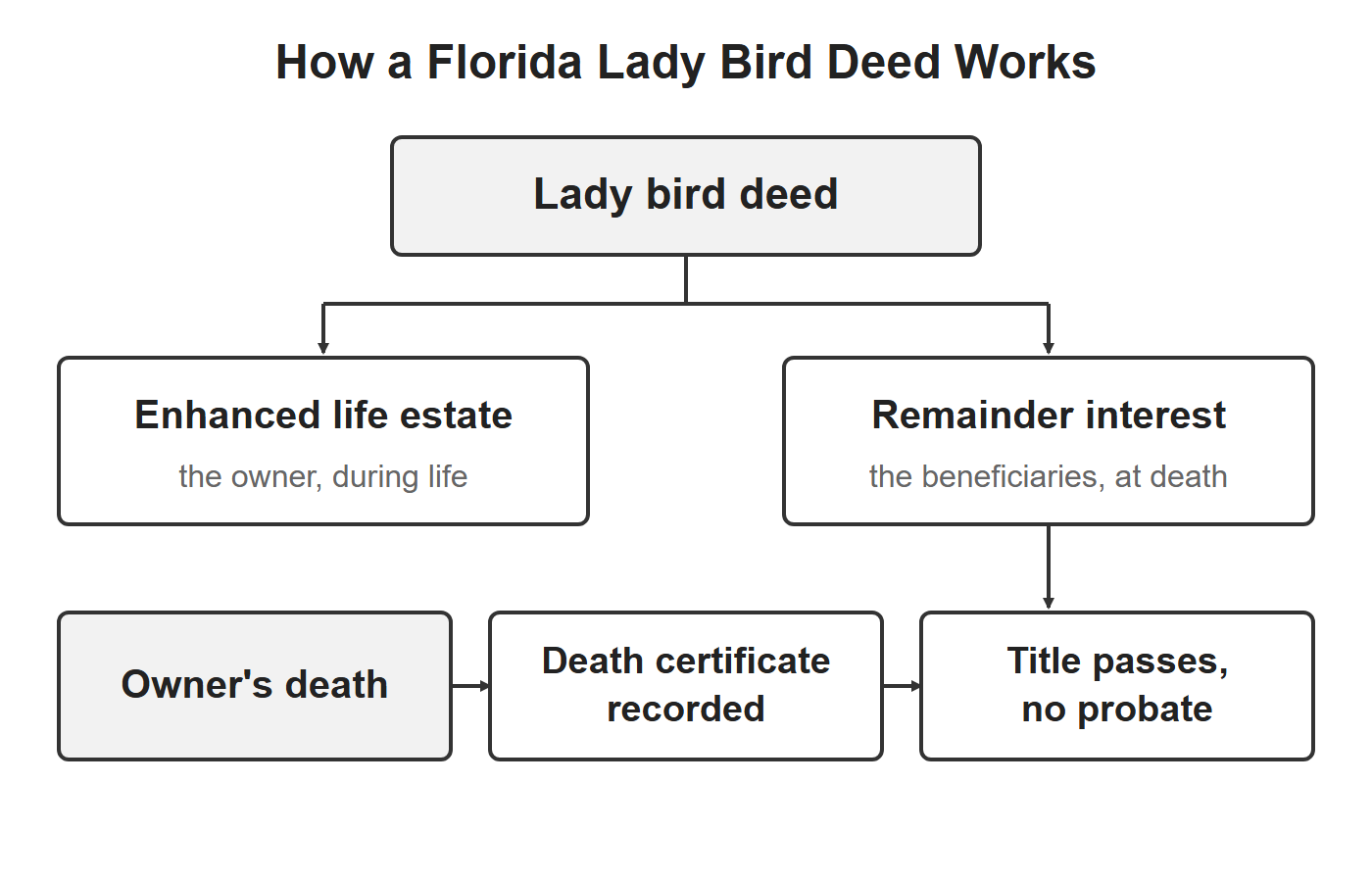
A lady bird deed divides ownership into two parts: an enhanced life estate held by the current owner and a remainder interest assigned to the named beneficiaries. For this reason, a lady bird deed is also called an enhanced life estate deed.
“Enhanced” is the word that separates this deed from a regular life estate deed. A regular life estate deed lets the owner live in the property but requires the remainder beneficiaries to join any sale or mortgage. A lady bird deed gives the owner the power to sell, mortgage, lease, or revoke the deed as if the beneficiaries did not exist.
Advantages of Lady Bird Deeds
A Florida lady bird deed avoids probate, gives the owner full control during their lifetime, is relatively inexpensive, and can help a person qualify for Medicaid. It is a good idea for a Florida homeowner whose main goal is passing one home to adult children, or to a surviving spouse, without probate.
1. Probate Avoidance
The property passes to the beneficiaries when the owner dies, with no probate case, court order, or new deed.
2. Full Control During Life
The owner can sell or mortgage the property, change the beneficiaries, or cancel the deed entirely, all without the beneficiaries’ permission. Because the owner has not given up ownership, the homestead exemption and the Save Our Homes cap generally stay in place during the owner’s life.
3. Low Cost
Attorney fees typically run $400 to $1,000, compared to $2,000 to $5,000 for a revocable living trust. Recording fees are set by statute and run under $50 for a standard deed.
4. Medicaid and Tax Treatment
Because the home passes outside probate, it generally stays beyond the reach of Florida’s Medicaid estate recovery program after the owner’s death. For tax purposes, the beneficiaries inherit the property at its date-of-death value, which can eliminate capital gains tax if they sell soon after.
Get a Lady Bird Deed
Attorney Gideon Alper prepares lady bird deeds for clients throughout Florida. We handle the drafting, execution, and recording.
See the price & book a consultation →
Disadvantages of Lady Bird Deeds
The main disadvantages of a lady bird deed are that it covers only one property, provides no creditor protection during the owner’s life, and cannot override a spouse’s or minor child’s homestead rights.
1. One Property, No Conditions
The deed covers a single property and transfers it outright at death. It cannot stagger distributions, hold property for a minor, or manage the property during the owner’s incapacity.
A lady bird deed is the wrong tool when the family situation includes a second marriage, a minor child, a beneficiary with financial problems, property in more than one state, or any plan that puts conditions on the inheritance. Those situations call for a living trust instead of a lady bird deed.
2. No Creditor Protection
The owner keeps full control, so judgment liens and creditor claims against the owner attach to non-homestead property exactly as they would without the deed.
3. Homestead Rights of a Spouse or Minor Child
A married owner who wants the homestead to go to someone other than the spouse needs the spouse both to join in the deed and to waive homestead rights. The waiver can be written into the deed itself. Homestead cannot be devised away from a minor child at all.
Are Lady Bird Deeds Legal?
Lady bird deeds are legal in Florida, but no Florida statute authorizes them. In Oglesby v. Lee (1917), the Florida Supreme Court gave effect to a deed in which the grantor kept lifetime possession and the right to resell. The Florida Bar’s Uniform Title Standards 6.10 through 6.12 (2019) tell title examiners how to treat enhanced life estate deeds, though the Bar adds that little case law supports the practice. Title companies throughout Florida accept properly drafted lady bird deeds.
Michigan, Texas, and Vermont also recognize lady bird deeds. Other states may allow similar transfers through transfer-on-death deed statutes, but those are separate instruments with different rules.
Requirements
A lady bird deed in Florida needs six things: a grantor, enhanced life estate language, named remainder beneficiaries, the property’s legal description, homestead language when applicable, and proper execution and recording.
1. Grantor
The grantor is the current owner of the property. The grantor splits ownership into two parts: an enhanced life estate for the grantor and a remainder interest for the named beneficiaries.
2. Enhanced Life Estate Language
The deed must include specific language reserving the grantor’s right to sell, mortgage, or lease the property and to revoke the deed without the beneficiaries’ consent. If the deed lacks that language, it creates only a regular life estate, and the owner loses the ability to act without the beneficiaries’ cooperation.
3. Remainder Beneficiaries
The deed names the people who will inherit the property at the grantor’s death. During the owner’s life, the beneficiaries have no right to occupy, manage, sell, or control the property. The owner can change the beneficiaries at any time by recording a new lady bird deed.
4. Legal Description
The deed must include the full legal description of the property from the prior deed or county records. A street address alone is not sufficient.
5. Homestead Language
If the property is the grantor’s Florida homestead, the deed should say so. When a married grantor names anyone other than the spouse as a remainder beneficiary of the homestead, the spouse must join in the deed and must also waive homestead rights, a waiver Florida law allows the deed itself to include. The joinder and the waiver together keep the deed from failing against the spouse’s constitutional interest under Florida homestead law.
6. Execution and Recording
A Florida lady bird deed must be signed in the presence of two witnesses and a notary, then recorded in the official records of the county where the property is located. No documentary stamp tax is due on the recording beyond the $0.70 minimum that clerks collect on a deed, because the deed transfers no present beneficial interest in the property. The Florida Department of Revenue takes that position even when the property carries a mortgage.
How Much Does a Lady Bird Deed Cost in Florida?
Attorney fees for a Florida lady bird deed typically range from $400 to $1,000. The cost varies with the attorney, the county, and the complexity of ownership and homestead status. Recording fees are modest, usually under $50 for a standard deed.
A living trust costs more, typically $2,000 to $5,000 for a revocable trust package, but covers more. For a homeowner whose estate is mainly one Florida residence, a lady bird deed may be the most cost-effective way to avoid probate on that property.
Florida Lady Bird Deed Form
A lady bird deed prepared from an online form can be legally valid if it contains the enhanced life estate language, a correct legal description, proper homestead language, and proper execution. Florida law does not require an attorney to prepare a deed. Some county clerks publish blank enhanced life estate deed forms.
Using a form saves a few hundred dollars in legal fees. Whoever fills one in must still settle four questions: whether the spouse must join and sign the homestead waiver, whether the homestead paragraph fits, what happens if a beneficiary dies first, and whether the legal description matches the chain of title. After the owner dies, a wrong answer to any of them leaves the family with a probate or quiet-title action that costs thousands and takes months.
Download this form: Word (.docx) | PDF · Part of our asset protection forms library.
Lady Bird Deed vs. Living Trust
A lady bird deed is simpler and less expensive than a living trust, but it covers only one property. A living trust can hold multiple assets, provide successor management during incapacity, include detailed rules for distributions, and handle contingencies like minor beneficiaries or blended families. A living trust is also a private document, while a recorded deed is public.
A lady bird deed is often a good fit when the plan is simple (one Florida home going to one adult child, or to adult children equally).
Lady Bird Deed and Florida Homestead
Lady bird deeds most often run into trouble with Florida homestead law, because the Florida Constitution restricts who can inherit homestead property when the owner is survived by a spouse or a minor child. If the owner leaves a minor child, the homestead cannot be devised to anyone, the spouse included. If the owner leaves a spouse but no minor child, the homestead can be devised only to that spouse.
A married homeowner who wants to leave the homestead to children through a lady bird deed must address the spouse’s constitutional interest. The spouse must join in the deed and, in addition, waive homestead rights, which can be done in the deed itself. Without both, the deed may fail after death and title companies may refuse to insure the transfer.
Lady Bird Deed and Medicaid
A lady bird deed’s Medicaid benefit is that it keeps the home out of Florida’s Medicaid estate recovery after the owner dies. Florida recovers Medicaid benefits only from the deceased recipient’s probate estate. Property that passes under a lady bird deed never becomes a probate asset, so it stays beyond the reach of estate recovery under current Florida law. The deed works whenever it is signed and recorded before death, even after the owner has entered a nursing home.
A lady bird deed does nothing for Medicaid eligibility. The Florida homestead is already an exempt asset for eligibility when the applicant lives in the home or intends to return. The home does not count toward the asset test at any value. But home equity above a separate federal ceiling bars long-term care coverage. That ceiling is indexed each year and does not apply when the applicant’s spouse, a child under 21, or a permanently and totally disabled or blind child lives there. Florida can also waive it for a demonstrated hardship.
Signing a lady bird deed also does not trigger Medicaid’s five-year lookback penalty. Florida’s Medicaid agency treats the deed as no transfer at all, because the owner keeps full power to sell or revoke. By contrast, an outright deed of the house to an adult child forfeits the homestead exemption and lands inside the five-year window that Medicaid counts back from the application. A lady bird deed passes the house to the child at death without either consequence.
Tax Consequences
A lady bird deed does not create a completed gift when recorded because the owner retains the power to revoke the deed or sell the property. No gift tax return is required simply because the deed is signed. Documentary stamp tax at recording is limited to the $0.70 minimum because the deed transfers no present beneficial interest, regardless of any mortgage on the property.
At death, the beneficiaries typically receive a stepped-up tax basis. They take the home at its date-of-death value as their tax basis, so a sale soon after produces little or no capital gain. The step-up happens because the owner kept a life estate, so federal estate tax law counts the home in the owner’s gross estate even though it skips probate. Property in the gross estate takes a date-of-death basis.
An outright lifetime gift of the home carries over the owner’s original basis and can require a gift tax return. The tax consequences of a lady bird deed are better on both counts.
How Do Creditors Interact with a Lady Bird Deed?
A lady bird deed does not protect the property from the owner’s creditors during the owner’s life. Because the owner keeps full control, non-homestead property remains subject to the owner’s judgment liens and other creditor claims. If a creditor could reach the property before the deed was signed, the creditor can reach it after. Recording the deed does not strip off a judgment lien that has already attached.
At death, the beneficiaries generally take the property free of any judgment lien against the owner that the creditor never enforced during the owner’s life.
A judgment against a beneficiary does not stop the owner from selling or mortgaging the property, because the owner can divest the beneficiaries at any time. The beneficiary’s creditors cannot force a sale while the owner is alive. After the owner dies, the property belongs to the beneficiaries and becomes subject to their own creditors.
A recorded IRS lien against a beneficiary attaches to that beneficiary’s remainder interest under federal law while the owner is still alive.
What Happens to a Lady Bird Deed When the Owner Dies?
A lady bird deed passes the property to the named beneficiaries without probate as soon as the owner dies. The beneficiaries record a certified copy of the death certificate in the county records. No probate petition, no court order, and no new deed is required.
If the beneficiaries plan to live in the property, they should apply for their own homestead exemption. The prior owner’s homestead exemption and Save Our Homes cap do not automatically carry over to the new owners.
If there is a mortgage, the beneficiaries inherit subject to the mortgage and must keep the loan current or refinance. Federal law generally prevents lenders from calling the loan due when property transfers to a relative at death and that relative lives there or will move in.
What If a Beneficiary Dies Before the Owner?
If a beneficiary of a lady bird deed dies before the owner, the deceased beneficiary’s share may pass through that beneficiary’s own estate unless the lady bird deed’s survivorship language sends it elsewhere. The remaining beneficiaries do not automatically inherit the share. The deceased beneficiary’s estate then has to be probated before title is clear.
A deed that names three children should say whether a deceased child’s share goes to the surviving children or to that child’s descendants. Survivorship or contingent-beneficiary language settles that question inside the deed.
The simplest fix while the owner is alive is to record a new lady bird deed with updated beneficiaries. The owner does not need consent from the prior beneficiaries to do this.
Alper Law has structured offshore and domestic asset protection plans since 1991. Schedule a consultation or call (407) 444-0404.